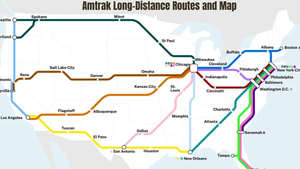
The history of passenger rail in the United States is linked to numerous long-distance routes that once served as vital transportation connections for travelers but were eventually discontinued for various reasons. As discussions regarding the revitalization of long-distance passenger rail in the U.S. gain momentum, the question naturally arises: could some discontinued Amtrak routes be reinstated? With this in mind, the Federal Railroad Administration (FRA)—through its Amtrak Daily Long-Distance Service Study—examined the potential for restoring old, discontinued, and non-daily long-distance services. However, the inclusion of a former route in the study does not guarantee that Amtrak service will resume there anytime soon. Restoring any service requires addressing several critical factors, including infrastructure, funding, agreements with host railroads, and operational planning.
What are Discontinued Amtrak Routes?
“Discontinued Amtrak routes” refers to passenger rail services that were once part of the Amtrak network but were subsequently shut down. Amtrak was launched in 1971, integrating various existing passenger services into a unified national network. Over the years, some routes were discontinued, others were modified, and the frequency of certain services was reduced. There is rarely a single reason for a route’s discontinuation; factors such as low ridership, operating costs, infrastructure limitations, equipment requirements, and funding availability can all influence a service’s future. Consequently, when discussing the potential restoration of an old route, it is not enough to simply note that a train once operated there; one must also assess current transportation demand and infrastructure conditions along that route.
Which Old Routes Could Return?
The FRA’s long-distance study conducted a comprehensive assessment of the potential for restarting discontinued routes and enhancing existing services. The study aimed to identify options that could connect major cities with smaller towns and rural communities. Potential restoration concepts focused on corridors that historically hosted passenger rail service and where future service could significantly improve connectivity within the national network. Therefore, it is premature to provide a definitive answer regarding exactly which trains will return. The feasibility and priority of different routes depend on factors such as infrastructure, estimated costs, public benefits, and community support.
The Role of Rural Communities in Restoring Old Routes
Rural America plays a significant role in discussions regarding the restoration of discontinued routes. Many former passenger rail routes passed through towns and communities where intercity transportation options may be limited today. Successfully restoring a route could provide people with an additional transportation option to reach major metropolitan areas, benefiting students, workers, families, tourists, and other travelers. In its study, the FRA has included the economic and social well-being of rural communities, as well as national passenger rail connectivity, as key considerations.
Will Old Train Services Be Restored in Their Original Form?
Not necessarily. If a discontinued route is brought back in the future, the service does not have to be identical to what it was in the past. Current passenger demand, population growth, travel patterns, and infrastructure conditions differ significantly from the situation decades ago. Therefore, planners may adjust route alignments, station locations, service frequency, travel times, and connections to meet present-day needs. In some instances, parts of the old route might remain useful, while other sections could require new infrastructure improvements. Consequently, modern rail planning views historical routes in the context of the current transportation network rather than simply replicating them.
Why Is Infrastructure Crucial for Route Restoration?
Simply providing a train is not enough to restart a discontinued Amtrak route. Passenger trains require tracks, stations, signaling systems, maintenance facilities, and sufficient operating capacity. Since many Amtrak trains operate on tracks owned by freight railroads, agreements with host railroads and track capacity become critical issues. If a route already carries heavy freight traffic, adding passenger service might necessitate infrastructure upgrades or scheduling adjustments. This is why the FRA study also took into account potential capital projects and infrastructure requirements.
New or Restored Routes Are Not Possible Without Funding
Funding is a crucial aspect of reviving any discontinued route. Launching and sustaining long-distance passenger rail service requires significant investment in trains, stations, infrastructure upgrades, maintenance, and operating expenses. Beyond federal funding, states and other partners can also play a role in such projects. Therefore, even if there is strong public demand for a route, its implementation depends on the availability of funding and overall feasibility.
What did the FRA Long-Distance Rail Study change?
The FRA prepared the Amtrak Daily Long-Distance Service Study between 2022 and 2024 and submitted the final report to Congress in January 2025. The study examined the restoration or enhancement of discontinued or non-daily services, as well as potential new long-distance routes. The FRA gathered feedback from states, local communities, Amtrak, railroads, and other stakeholders. This process helped identify communities where there is a need for and support for passenger rail. While the final report provides a framework for future planning, it does not, in itself, constitute approval to restart any specific discontinued route.
What does this mean for passengers?
If certain discontinued Amtrak routes are successfully restored in the future, it would mean more travel options and improved national connectivity for passengers. Such routes could be particularly beneficial for those wishing to avoid long-distance driving or seeking alternatives to air travel. Additionally, restored services could support tourism and connect smaller towns to major population centers. However, passengers should keep in mind that there are significant planning and implementation steps between a proposed restoration and the actual launch of train service.
Conclusion
The potential revival of discontinued Amtrak routes is a significant topic regarding the future of passenger rail in the United States. The FRA’s long-distance study demonstrates that the possibilities of restoring old routes, improving existing services, and developing new connections are being seriously examined. Nevertheless, the return of a specific train service should only be considered confirmed once Amtrak, the FRA, or relevant authorities officially announce its implementation. Factors such as funding, infrastructure, railroad agreements, operating requirements, and community support will play a crucial role in determining which old rail connections might actually be restored in the future.
FAQs
Q1. What are discontinued Amtrak routes?
A. They are former Amtrak passenger routes that were discontinued and are no longer operating as regular services.
Q2. Could discontinued Amtrak routes return?
A. Some could potentially return, but restoration depends on funding, infrastructure, demand, and railroad agreements.
Q3. Why bring back discontinued Amtrak routes?
A. Restored routes could improve connections between major cities, smaller towns, and rural communities across the United States.