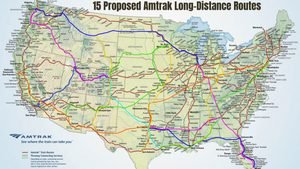
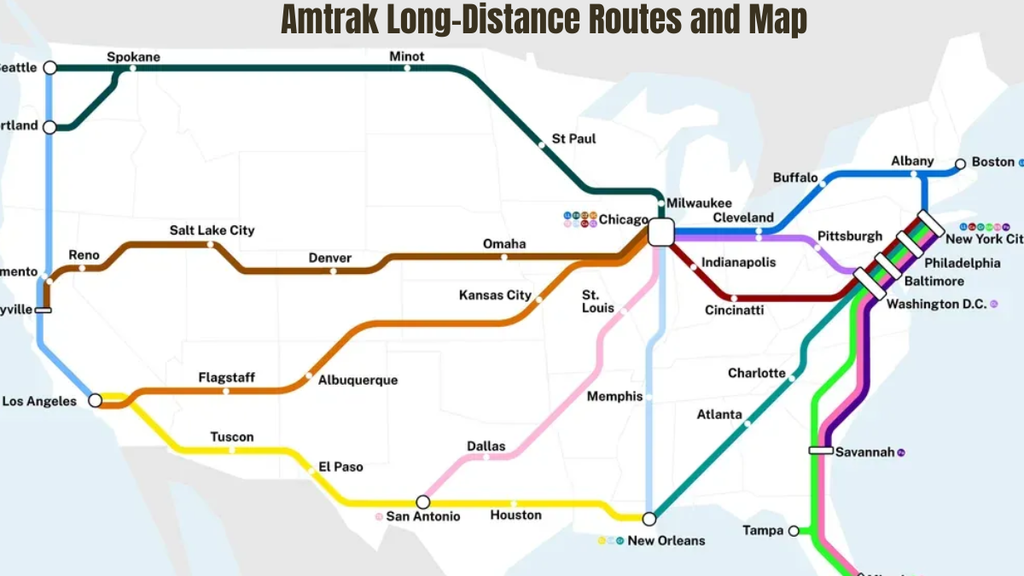
Amtrak’s long-distance rail network is a vital component of the U.S. passenger rail system, connecting various parts of the country through long-haul train services. These trains serve not only as a means of travel between major cities but also link numerous small towns and rural communities to the national transportation network. According to the Federal Railway Administration (FRA), Amtrak Map currently operates 15 long-distance routes, serving communities across 39 states in the contiguous United States. The FRA generally defines a long-distance route as an Amtrak route spanning more than 750 miles between its endpoints.
What are Amtrak long-distance routes?
Amtrak long-distance routes are passenger train services designed for long-haul intercity travel. These routes offer passengers the opportunity to travel across multiple states and diverse geographical regions. Some trains operate overnight and feature sleeping accommodations, making long journeys more comfortable. Amtrak’s national network encompasses long-distance routes alongside the North-east Corridor and state-supported services; therefore, understanding the distinctions between these service categories is useful when viewing a route map. According to Amtrak’s national network information, long-distance services span a vast area of the country, reaching many locations where other intercity transportation options may be limited.
Key Amtrak Long-Distance Routes
Amtrak’s long-distance network includes several renowned routes. For instance, the Empire Builder travels between Chicago and Seattle/Portland via the northern United States, while the Coast Starlight traverses the stunning landscapes of the West Coast between Los Angeles and Seattle. The City of New Orleans connects Chicago and New Orleans, offering a travel experience along the Mississippi River region. Additionally, services such as the South-west Chief, California Zephyr, Texas Eagle, and Sunset Limited connect various regions across the United States. Amtrak itself highlights routes like the Empire Builder, City of New Orleans, and Coast Starlight as some of its iconic long-distance travel experiences.
How to Understand the Amtrak Route Map?
At first glance, Amtrak’s route map can appear quite vast and complex because it displays long-distance, state-supported, and North-east Corridor services within a single national network. In Amtrak’s FY2026 information, long-distance routes are depicted as a distinct category on the national network map. When planning a trip, rather than simply choosing a route based on a line on the map, it is important to consider which stations the train serves, the frequency of service, and how many connections are required between your origin and destination. Amtrak’s online train-tracking system also allows users to view routes, stations, and active trains on a map, making it easier for passengers to understand the network.
The Experience of Long-Distance Train Travel
A long-distance Amtrak journey can differ significantly from a typical commuter train ride. Passengers often spend many hours or even an entire night on board, meaning the journey itself becomes an integral part of the travel experience. In addition to standard seating, long-distance services may offer sleeping accommodations, dining, and lounge facilities on certain routes. Passengers travelling on scenic routes have the opportunity to view mountains, forests, deserts, rivers, and vast, open landscapes along the way. Consequently, many travellers view long-distance train travel not merely as a means to reach a destination but as a scenic American travel experience in its own right.
Why Are Long-Distance Routes Important for Rural Communities?
One of the key features of Amtrak’s long-distance network is that many of its services connect major metropolitan areas with small towns and rural communities. According to the FRA, Amtrak’s 15 long-distance routes serve stations across 39 states, providing intercity passenger transportation to rural communities that might otherwise lack adequate service from other modes of transport. The significance of this connectivity extends beyond tourism; improved passenger rail connections can facilitate access to healthcare, education, employment, family visits, and regional economic opportunities.
FRA Long-Distance Rail Study and Future Routes
Amtrak’s existing long-distance network may expand further in the future. Through the Amtrak Daily Long-Distance Service Study, the FRA examined the possibilities of restoring discontinued routes, upgrading non-daily services to daily operations, and establishing potential new long-distance routes. The study also assessed how new or restored routes could connect large and small communities into a regional rail network, benefit rural areas, and strengthen national passenger rail connectivity. The FRA conducted this study between 2022 and 2024 and submitted the final report to Congress in January 2025.
Amtrak’s existing long-distance network could expand further in the future.
Through the Amtrak Daily Long-Distance Service Study, the FRA examined the possibilities of restoring discontinued routes, upgrading non-daily services to daily operations, and introducing potential new long-distance routes. The study also explored how new or restored routes could connect large and small communities into a regional rail network, benefit rural areas, and strengthen national passenger rail connectivity. The FRA conducted this study between 2022 and 2024 and submitted the final report to Congress in January 2025.
The Future of Amtrak Long-Distance Rail
Efforts are also underway to modernise long-distance passenger rail in the United States. Advancing its long-distance fleet replacement strategy, Amtrak initiated the procurement process for new long-distance passenger cars in 2026. According to Amtrak, the goal of the new fleet is to replace ageing passenger cars and provide a more consistent and accessible experience for long-distance travellers. This implies that the future of the long-distance rail network may focus not only on new routes and improved connectivity but also on modern trains and an enhanced passenger experience.
Conclusion
Amtrak’s long-distance routes form a vital part of the backbone of America’s passenger rail network. These routes connect major metropolitan areas, small towns, and rural communities, enabling journeys spanning thousands of miles. While the existing 15 long-distance routes already serve 39 states, the FRA’s long-distance rail study outlines potential directions for future restoration and expansion. Therefore, if you wish to understand scenic train travel, cross-country transportation, or the future of passenger rail in the United States, Amtrak’s long-distance route network serves as a significant starting point.
FAQs
Q1. How many Amtrak long-distance routes are there?
A. Amtrak currently operates 15 long-distance routes serving communities across 39 states.
Q2. What is considered an Amtrak long-distance route?
A. An Amtrak long-distance route is generally a route that covers more than 750 miles between its endpoints.
Q3. Where can I find the Amtrak long-distance route map?
A. You can view Amtrak’s national route map to explore long-distance routes, stations, connections, and destinations.