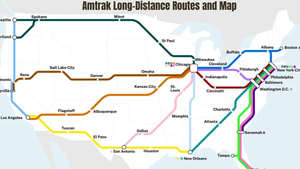
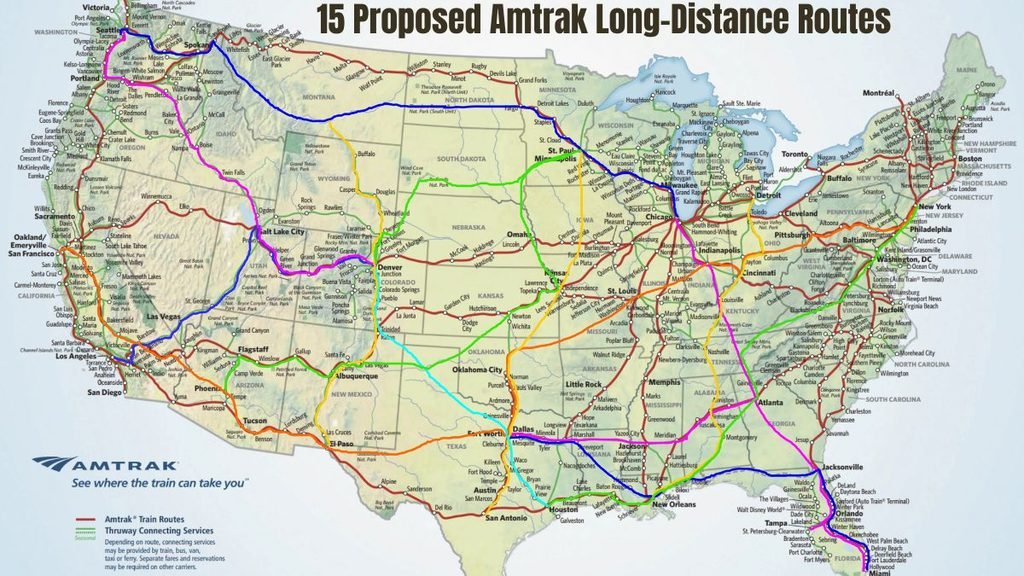
A major question regarding passenger rail in the U.S. has been a topic of ongoing discussion in recent years: could Amtrak’s long-distance train service eventually reach cities and states that currently lack regular passenger rail connections? To explore this, the Federal Railroad Administration (FRA) prepared the Amtrak Daily Long-Distance Service Study.
The study aimed to identify potential new routes, restore discontinued long-distance services, and upgrade existing non-daily services to daily operations. Therefore, the “15 proposed Amtrak long-distance routes” should not be viewed merely as a list of confirmed new train services; rather, they represent potential service concepts and planning options that would require further funding, infrastructure development, agreements, and operational planning.
What is the concept behind the proposed Amtrak long-distance routes?
The core idea behind the FRA’s long-distance study is to create a more interconnected passenger rail network across the United States. By definition, long-distance passenger rail service refers to Amtrak routes spanning more than 750 miles between endpoints. The study specifically considered routes that were once part of the passenger rail network but were subsequently discontinued, as well as potential new connections linking major metropolitan areas with smaller towns and rural communities. The goal is not simply to launch new trains but to build a network that offers travelers a wider range of transportation choices between different parts of the country.
Improved Connection from Chicago to Texas
Potential routes strengthening passenger rail connectivity between the Midwest and Texas have long been a subject of interest. A service connecting a major transportation hub like Chicago to key Texas cities could offer travelers an alternative travel option across multiple states. The utility of such a route would not be limited to major cities alone; smaller communities along the way could also gain access to stations and improved regional connectivity.
Dallas–Fort Worth and Houston Regions
Texas is one of the largest states in the U.S., and there is significant demand for passenger transportation between its metropolitan areas. The idea of improved rail connectivity linking Houston, Dallas–Fort Worth, and other Texas communities has long been a topic of discussion in transportation planning. If long-distance or extended-distance services are developed in the future, they could play a role in strengthening connectivity between Texas’s existing rail network and the national Amtrak system.
Potential Expansion Involving Atlanta and the Southeast
Atlanta is a major transportation and population center in the Southeastern United States. Consequently, long-distance concepts that better connect Atlanta to other major cities and existing passenger rail corridors could be highly significant. This could offer travelers additional options for rail-based connections within the Southeast and to other parts of the country.
Rail Connectivity in the Gulf Coast Region
Passenger rail connectivity is a crucial issue for Gulf Coast communities. Rail service between New Orleans and nearby Gulf Coast cities could benefit tourism, business travel, and local connectivity. Such services could also appeal to passengers who prefer train travel over long road journeys or domestic flights.
Potential Services Between Florida and the Southeast
Florida is a major U.S. tourism destination and a region with a rapidly growing population; therefore, there is sustained interest in passenger rail services connecting Florida to the Southeast and other parts of the country. Long-distance rail expansion could create new travel options for tourists, families, and business travelers, although detailed assessments regarding feasibility, infrastructure, and funding would be essential before launching any proposed service.
New Long-Distance Connections in the Midwest
Chicago is already a vital hub within the Amtrak network in the Midwest. Enhancing long-distance connectivity from there to other states and regions could make the national rail network more interconnected. Notably, many small and medium-sized communities in the Midwest are located far from major cities; thus, long-distance passenger rail could serve as a crucial means of regional accessibility for them.
Potential Expansion in the Western United States
Distances in the Western United States are vast, with many communities situated far apart. In such a region, the importance of long-distance passenger rail is even greater. Potential concepts connecting California, Nevada, Arizona, Colorado, Utah, and surrounding regions could cater to both scenic tourism and practical transportation needs.
Opportunities for Mountain and Rural Communities
One of the key features of long-distance rail is that it does not rely solely on major metropolitan areas; many routes pass through small towns and rural communities. Developing new services could provide these communities with better transportation access to employment centers, healthcare facilities, universities, and major cities. The FRA study prioritizes factors such as rural economic and social well-being alongside national connectivity.
Will these 15 routes definitely be launched?
This is a crucial point for travelers to understand: a proposed route is not the same as an approved route. While the FRA study offers information and recommendations for future planning, the actual operation of a route may require several subsequent steps. These could include securing federal or state funding, developing railroad infrastructure and track capacity, reaching agreements with host railroads, and arranging for equipment, stations, and operating plans, among other approvals. Therefore, it would be inaccurate to label a proposed route as an “upcoming Amtrak train” until its official implementation has been announced.
How might travelers benefit from new Amtrak routes?
If some of the proposed long-distance services materialize in the future, the primary benefit would be an expansion of transportation choices. Travelers would have an alternative to driving or flying for long-distance journeys. Additionally, rural communities could gain better connections to major cities, tourism destinations could attract more visitors, and regional businesses could access new economic opportunities. Long-distance trains could also offer overnight travel options, providing a unique and comfortable travel experience for many passengers.
Long-term significance of the FRA study
The FRA Long-Distance Rail Study serves as a planning framework for the future of passenger rail in the United States. The final study evaluates various aspects—such as potential options, infrastructure requirements, estimated costs, and public benefits—associated with restoring, enhancing, and expanding long-distance services. Throughout the study process, the FRA gathered feedback from states, communities, Amtrak, railroad companies, and other stakeholders. This highlights that future passenger rail planning is not solely the domain of the federal government; the participation of local communities and transportation organizations is equally vital.
Conclusion
The proposal for 15 Amtrak long-distance routes in the United States is part of a significant discussion aimed at making the passenger rail network more comprehensive and interconnected. These potential routes seek to link major metropolitan areas with small towns and rural communities, strengthen the existing rail network, and expand transportation options for travelers. However, these proposed routes should not yet be considered guaranteed train services.
Transforming each route into reality will require several steps, including securing funding and infrastructure, establishing railroad agreements, and conducting detailed planning. Nevertheless, the FRA’s long-distance study clearly indicates that there is significant future potential for the expansion and modernization of long-distance passenger rail in the United States.
FAQs
Q1. What are proposed Amtrak long-distance routes?
A. They are potential routes being considered to expand or restore long-distance passenger rail service across the U.S.
Q2. Will all 15 proposed Amtrak routes be launched?
A. Not necessarily. Proposed routes still require further planning, funding, infrastructure, and other approvals.
Q3. Why are new Amtrak long-distance routes important?
A. They could improve connections between major cities, smaller communities, and rural areas while giving travelers more transportation options.