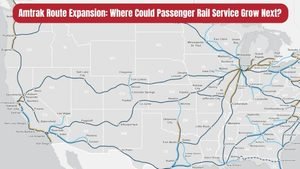
Discussion about strengthening the passenger rail network in the United States has intensified in recent years. Particularly with regard to long-distance Amtrak Routes service, the question of which cities and regions could receive new train connections in the future has become crucial. The Federal Railroad Administration’s (FRA) Long-Distance Rail Study also examined the potential for improving existing services, reviving discontinued routes, and establishing new long-distance connections. However, the potential or proposed location of a route in 2026 does not necessarily guarantee regular Amtrak trains will begin operating there that year. Numerous steps, including funding, infrastructure, railroad agreements, and detailed planning, must be completed to make a new route a reality.
Which cities could receive new long-distance rail service?
When discussing the potential for new Amtrak service, special attention is paid to areas with large populations, growing communities, or limited intercity transportation options. Potential long-distance routes could aim to connect different regions and connect cities currently lacking direct long-distance service to the national passenger rail network. Some proposals could involve the revival of old rail corridors or historic passenger routes, while others could be based on entirely new connections. This could open up new rail connectivity opportunities in the Midwest, Southeast, Southwest, and other regions in the coming years.
Potential for New Amtrak Connectivity in the Midwest
The Midwest is one of the regions in the United States that has long attracted interest in passenger rail expansion. New or expanded routes connecting to major rail hubs like Chicago could provide improved connectivity to many small and medium-sized cities. Due to the region’s population centers and existing railroad infrastructure, some corridors could be suitable for long-distance or expanded passenger service. If funding and infrastructure capacity are available, new connections in the Midwest could offer travelers an additional option beyond road and air travel between major cities.
Potential Expansion in the Southeast and Southern States
The Southeast is also considering the potential for new Amtrak connections due to passenger rail demand and population growth. Many southern communities are connected to major cities, but direct long-distance rail options between them may be limited. Regional tourism, family travel, and business connectivity could benefit from the introduction of new services. However, even here, route selection will not be based solely on population. Factors such as track availability, freight traffic, station infrastructure, and operating costs will be important in determining whether a proposed service is viable.
Could Old Amtrak Routes Return?
New Amtrak routes don’t always mean building entirely new railroad corridors. Some proposals may focus on restoring previously discontinued passenger services. The return of old routes can be attractive because, in many cases, existing railroad corridors and stations already exist. However, resuming service after decades requires re-evaluating current population, travel patterns, infrastructure condition, and financial feasibility. Therefore, the existence of a historical route does not in itself guarantee its return.
The Biggest Challenges in Launching a New Amtrak Route
Launching a new long-distance train route can be a complex and lengthy process. First, it’s important to determine whether there will be sufficient passenger demand on the proposed route. Infrastructure requirements such as track capacity, signals, bridges, stations, and maintenance facilities are then studied. Many routes may share freight railroad tracks, so agreements and scheduling with the host railroad are crucial. Furthermore, the availability of locomotives, passenger cars, and trained crews also plays a major role in service launch.
A New Amtrak Route Is Not Possible Without Funding
Adequate funding is one of the most important requirements for a new long-distance passenger rail service. Initial infrastructure improvements, as well as recurring financial support for long-term train operation, are needed. Federal funding, state contributions, and other public partnerships can help move potential projects forward. Therefore, it’s not fair to assume a proposed route will be operational immediately. Funding and implementation priorities must be determined first.
What should travelers expect in 2026?
The most important thing in 2026 is to view passenger rail expansion as a long-term process. Discussions of potential routes and cities are certainly encouraging for travelers, but there can be many administrative and infrastructure stages between a study or proposal and actual Amtrak service. If a route moves forward, it will then undergo phases such as planning, funding, agreements, infrastructure work, and service preparation. Therefore, travelers should await official announcements and confirmed schedules.
The Future of Amtrak in the United States
The potential for new Amtrak routes is part of the bigger picture for the future of America’s passenger rail network. If some of the proposed and restored services receive funding and infrastructure support, many communities could gain better connectivity to the national rail network in the coming years. Daily service expansion, the return of discontinued routes, and new city-to-city connections could make Amtrak’s long-distance network more useful.
Conclusion
The topic of New Amtrak Routes 2026 is of great interest to both travelers and rail enthusiasts, but it’s important to understand potential routes as distinct from confirmed services. Which cities will actually receive long-distance train service will depend on factors such as passenger demand, infrastructure, funding, and government and railroad partnerships. Nevertheless, the FRA’s long-distance rail planning has sparked an important discussion about passenger rail expansion in the United States. In the years to come, this planning could help determine which cities will become part of new Amtrak connections and the direction America’s long-distance rail network will take.