

Have you ever thought, “I’ll just have one cookie,” only to find a second one in your hand the moment the first was finished? This doesn’t always signal intense hunger. Our eating habits can be influenced by taste, environment, routine, emotions, and the brain’s reward system. Consuming sweet, delicious treats like cookies triggers a pleasurable response in the brain, making the urge to reach for a second one quite natural.
Taste can prompt the brain to want more
The sweetness, fat content, and satisfying texture—whether crunchy or soft—make eating a cookie a pleasurable experience. When an eating experience is enjoyable, our brain may desire to repeat it. That is why, after the first cookie, we might tell ourselves, “What’s the harm in having just one more?” It becomes less about satisfying hunger and more about the pleasure derived from the taste.
How the “just one more” mindset begins
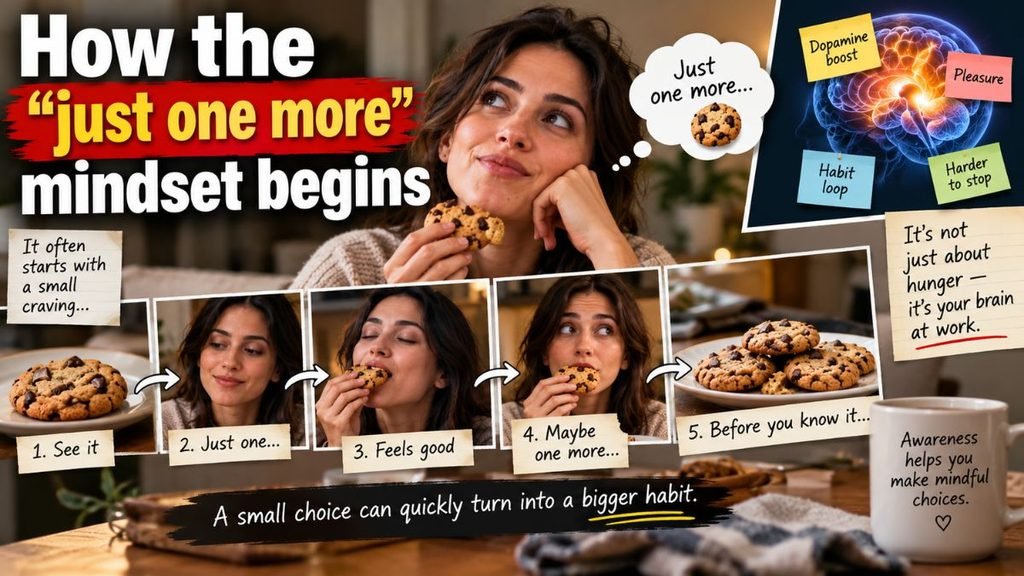
After eating the first cookie, one might convince oneself that having a second one isn’t a big deal. That same line of reasoning can easily extend to a third cookie. It involves a subtle mental process where each subsequent decision feels easier to make than the last—especially when an open box of cookies is right in front of you, making it effortless to grab another.
Food within sight can be more tempting
If an open cookie jar is right in front of you, seeing it repeatedly can heighten the urge to eat. Conversely, if the cookies are stored in a closed cupboard, getting one requires extra effort. This shows that our eating behavior is influenced not just by hunger but also by our immediate environment.
Stress and emotions can also play a role

Some people are more drawn to sweets when they are stressed, bored, or tired. In such moments, a cookie ceases to be merely food; it becomes a source of temporary comfort or a way to distract oneself. So, if someone finishes an entire packet of cookies whenever they are stressed, it wouldn’t be accurate to attribute this behavior solely to “poor self-control.” There may be an underlying emotional habit at play.
Habits simplify the decision to eat
If someone develops a habit of eating cookies with their evening tea, their body and mind eventually begin to recognize that routine. The cup of tea, the packet of cookies, and the time for relaxation become linked. In such cases, the person might crave a cookie even when they aren’t hungry, simply because their brain has associated that specific situation with eating.
Large packages can make overeating easier

When a large packet or jar of cookies is right in front of you, it can be difficult to decide exactly how many to eat. Instead of taking out one cookie at a time, eating directly from the packet can cause you to lose track of the quantity consumed. Portioning out a small amount beforehand can make it easier for many people to keep an eye on how much they are eating.
This doesn’t mean everyone loses control
Eating more than one cookie isn’t a problem in itself; enjoying delicious food occasionally is perfectly normal. The issue arises when someone repeatedly eats more than they intended and subsequently feels distressed or guilty. Therefore, it is important to distinguish between having a casual snack and consistently eating out of control.
Understand the pattern instead of blaming yourself

If you find yourself unable to stop after just one cookie, rather than labeling yourself as having weak willpower, it is more helpful to observe when this happens. Are you stressed? Do you eat while watching TV? Is the packet always within sight? Or has it become part of your daily routine? Recognizing these patterns can be the first step toward understanding your eating habits.
It is important to understand both the mind and the environment
The urge to eat another cookie after the first one isn’t just about hunger. Taste, rewards, habits, emotions, and the surrounding environment can all combine to influence our food choices. So, the next time you find yourself telling yourself “just one more” in front of the cookie jar, try to understand your eating pattern instead of simply attributing it to a lack of self-control. Often, understanding your behavior is the first step toward managing it better.
FAQs
Q1. Why can’t some people stop at one cookie?
A. Cravings, habits, taste, and the brain’s reward system can make it difficult to stop after one.
Q2. Is eating several cookies always about hunger?
A. No. Emotional triggers, habits, and the enjoyment of sweet foods can also influence eating.
Q3. Can you learn to stop after one cookie?
A. Yes. Being mindful while eating and understanding your cravings can help improve self-control.